EXAONE systems predict factory defects, discover materials, explain financial forecasts
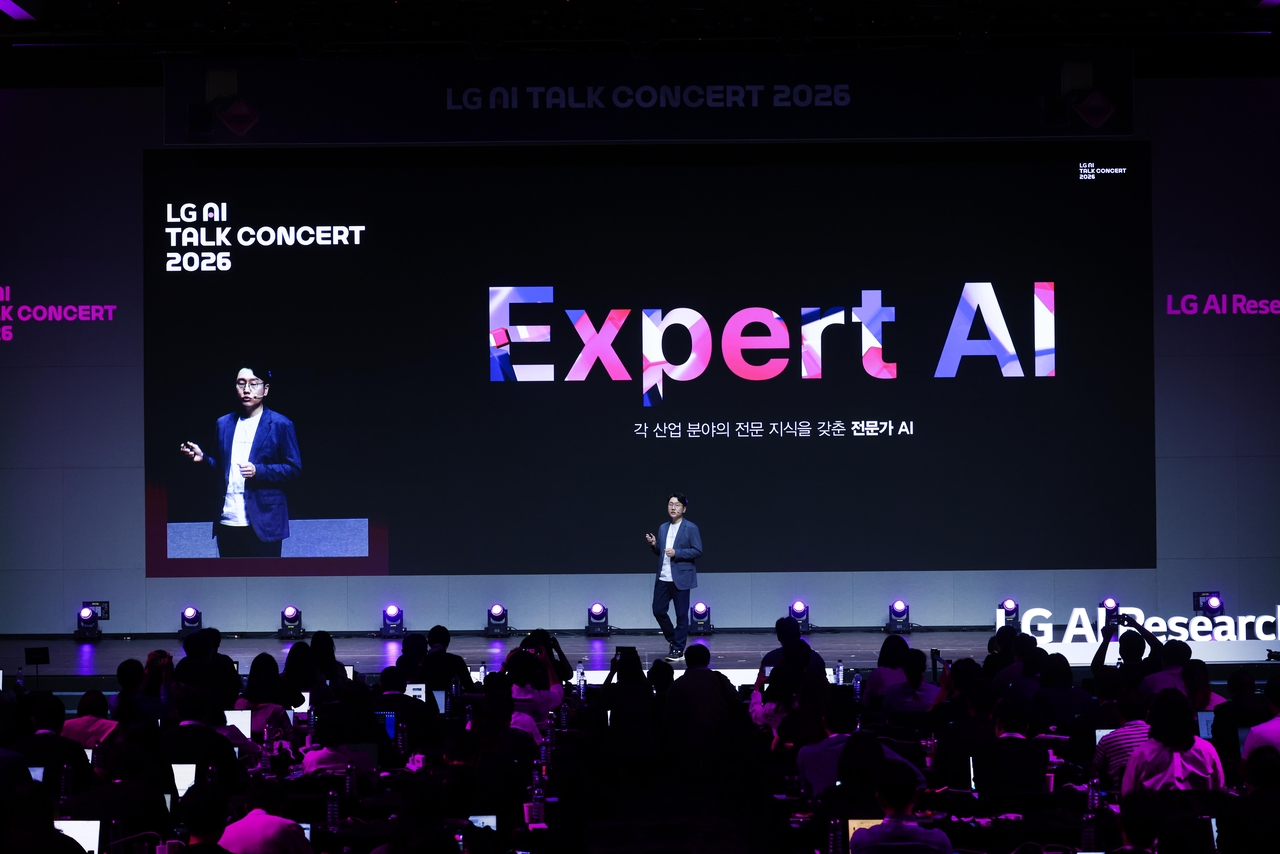
LG AI Research unveiled a suite of industry-specific systems Monday, accelerating its push to build artificial intelligence that does more than answer questions — it predicts problems, makes decisions and takes action.
At its AI Talk Concert 2026 in Seoul, the research institute introduced specialized models that can detect factory defects before they occur, accelerate the discovery of new materials and produce explainable financial forecasts. It also laid out plans for autonomous laboratories and factories where AI systems can initiate and coordinate work with less human intervention.
“Our goal is not simply to build good AI models,” said Lim Woo-hyung, co-head of LG AI Research. “We are focused on solving difficult problems that industries have been unable to address for years.”
General-purpose models may generate impressive answers, Lim said, but industrial AI must process hundreds of variables, identify rare exceptions and produce measurable improvements in cost, productivity and quality.
He said LG’s access to real-world operations across its affiliates and partner companies gives its expert AI models an advantage over systems developed without deep industrial data or operating experience.
In manufacturing, LG introduced EXAONE Tabular, which uses production data to predict defects and optimize operating conditions, and EXAONE Omni-Inspect, which can adapt visual inspections to new products and factory environments with minimal additional training.
LG plans to combine these systems with robot foundation models, eventually creating an “AI orchestrator” capable of monitoring factories and coordinating robots, inspection equipment and production systems.
For scientific research, EXAONE Discovery analyzes data to design new materials and predict synthesis outcomes. LG said the system screened more than 420,000 compounds in a single day to identify Rhamsydil, a potential hair-loss treatment ingredient under development with LG Household & Health Care.
The model is also being used in projects with GS Caltex to develop cooling fluids for AI data centers and with D&D Pharmatech to advance oral peptide drugs.
LG also outlined plans for an autonomous laboratory in which AI designs experiments, robotic equipment conducts them around the clock and the results inform the next round of testing.
In finance, EXAONE Business Intelligence deploys multiple AI agents to analyze companies, forecast share-price movements and explain the reasoning behind its projections. The service covers about 8,000 listed companies in South Korea and the US.
LG is working with London Stock Exchange Group to bring the service to global investors and with Koscom to expand its domestic reach.
Since its establishment in 2020, LG AI Research has addressed more than 100 industrial problems, published 368 papers at leading AI conferences and filed more than 1,000 patent applications, Lim said.
In a statement, LG Corp. Chair Koo Kwang-mo said changing technology and rising customer expectations require the group to move beyond the formulas that drove its past success.
“We are at an inflection point where a new future is opening,” Koo said. “It is both our responsibility and our opportunity to build a better future.”
Korea emerges as AI contender
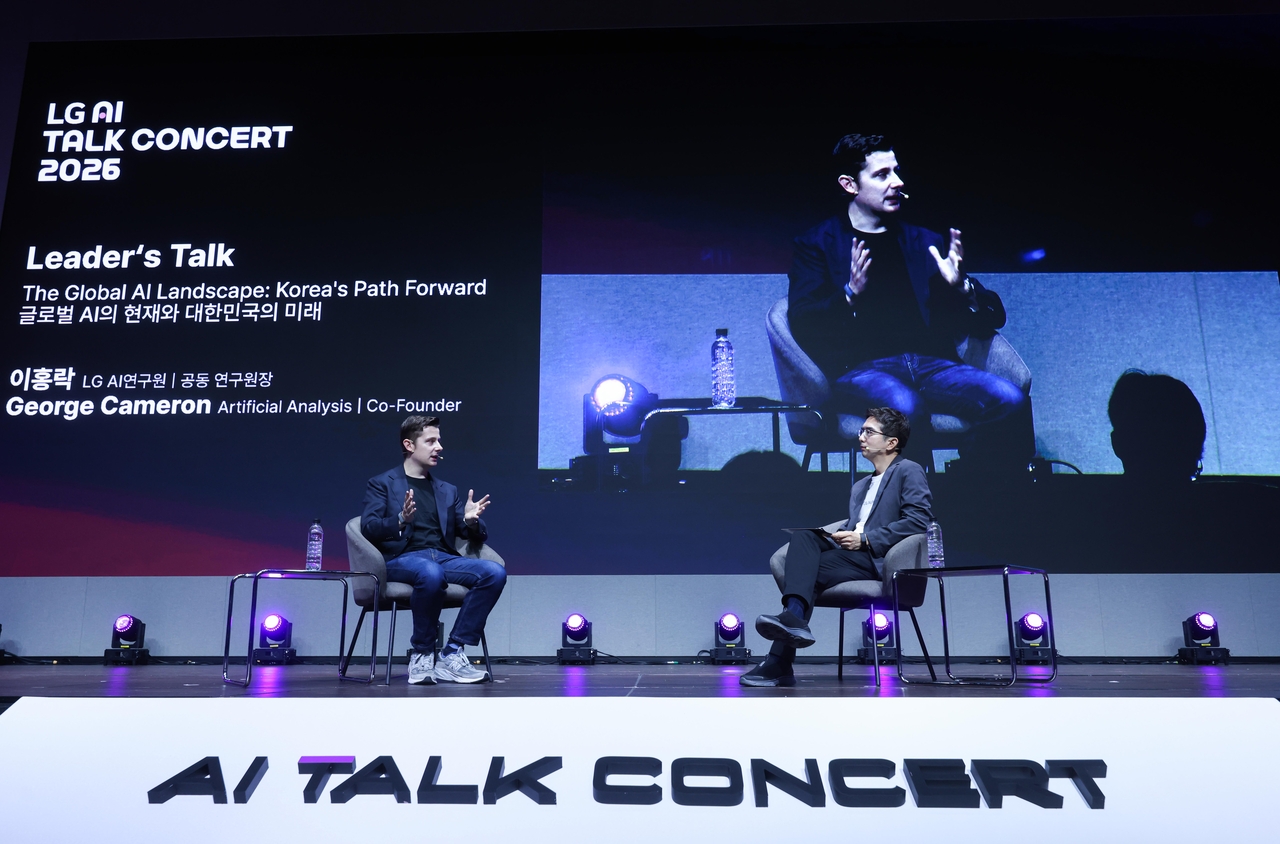
Speaking at the event, George Cameron, co-founder of independent benchmarking firm Artificial Analysis, said South Korea has rapidly emerged as one of the world’s three leading AI countries, behind only the US and China when measured by the intelligence of their strongest models.
“Korea is an inspiration to the world in showing what can be achieved when a country commits to AI,” Cameron said, crediting Korean developers and the government’s sovereign AI initiative.
“It has strength and depth not only in infrastructure but also in talent. Korea has shown that if you believe in that talent and invest in it, you can make fast progress.”
Korean models still trail the leading American and Chinese systems in general intelligence, Cameron said. However, they can compete on cost, Korean-language performance and the flexibility offered by open-weight models.
He urged Korean developers to capitalize on the country’s strengths in advanced manufacturing and corporate knowledge while continuing to pursue progress toward artificial general intelligence.
Cameron identified AI for science, long-running workplace tasks, coding and autonomous agents as key areas of development as models move from answering questions to carrying out complex assignments and acting in the physical world.
“We should expect agents to move from being reactive to proactive,” Cameron said. “That is what we expect from our colleagues, and it is what we should expect from AI agents.”
herim@heraldcorp.com